A garage door can look acceptable while hiding worn springs, loose cables, or failed safety sensors. That is why homeowners often ask, “Should I repair or replace my garage door?” The answer depends on age, damage, operating noise, safety performance, and long-term cost. A door that shudders across its tracks deserves attention. So does one that drops suddenly, leaves gaps, or refuses to reverse during testing.
Industry educator Tom Wadsworth describes the risk clearly: “The garage door is the largest moving object in your home.” His warning gives this decision real weight. The Door & Access Systems Manufacturers Association recommends regular visual checks, balance testing, and safety-reversal testing. The U.S. Consumer Product Safety Commission also emphasizes professional attention to dangerous door components, especially springs and cables. Do not adjust those parts casually.
Replacement may also make financial sense. Zonda’s 2024 Cost vs. Value Report found that an upscale garage-door replacement recovered about 193.9% of its national project cost at resale. That figure is impressive, but it is not a promise for every home. Local labor prices, door materials, climate, and installation quality can change the result. A repair may be wiser when the door is newer and the damage is isolated. An older door with repeated failures may only be postponing the same decision.
This guide examines the top ten warning signs. Some are obvious. Others are easy to ignore. That hesitation can be expensive. A careful inspection, a written estimate, and a qualified technician can reveal whether your garage door needs a targeted repair or a safer replacement.
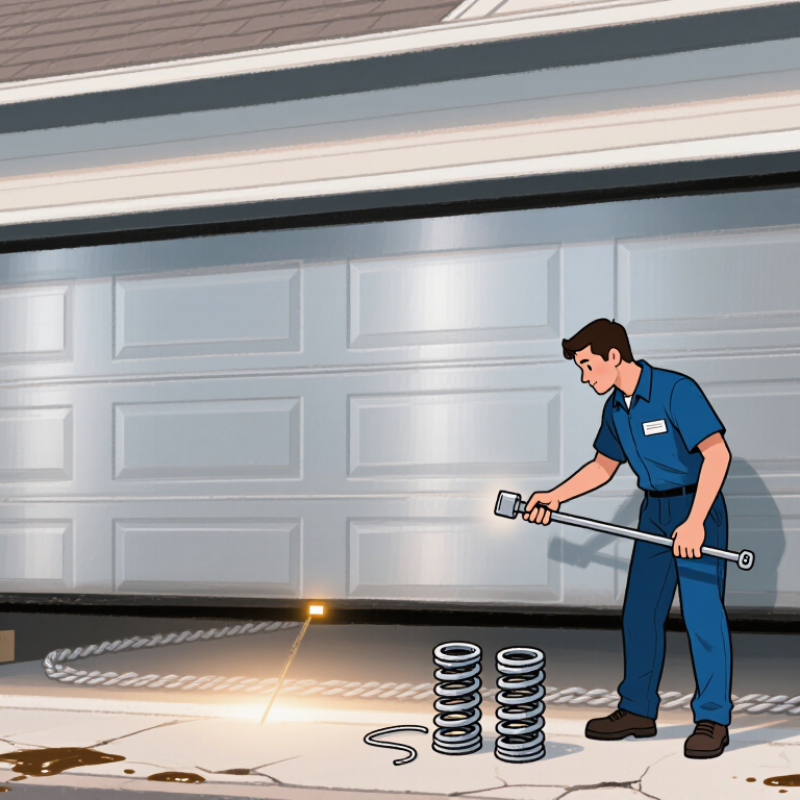
Top 10 Signs You Should Repair or Replace Your Garage Door?
Assessing Door Age Against the Typical 15–30-Year Service Life
Most garage doors serve about 15–30 years, depending on use, weather, installation, and maintenance. Age alone does not demand replacement. A carefully maintained 25-year-old door may outperform a neglected 10-year-old door. However, repeated breakdowns can reveal a larger problem. Watch for sagging panels, deep rust, cracked rollers, uneven movement, loud grinding, and visible cable damage. Frequent repairs may also cost more than a modern replacement. During inspections, technicians check balance, spring condition, track alignment, and the door’s response to safety sensors. A door that reverses unpredictably deserves immediate professional attention.
Small details matter. Feel the vibration through the floor. Notice daylight around warped panels. Listen for sharp popping sounds near the springs. These clues can indicate wear beyond a simple adjustment. Insulation also matters in attached garages, especially when nearby rooms become unusually hot or cold. Older doors may lack current safety features, but replacement decisions should follow a qualified inspection and local requirements. I have seen homeowners replace doors too quickly, while others ignore serious damage for years. Both choices can be costly.
Tips: Record repair dates and expenses. Test the auto-reverse function monthly with a soft object. Never adjust springs or cables without proper training. Ask an experienced technician whether repair, partial replacement, or full replacement offers the safer long-term value. Getting a second opinion is sensible, especially when the door is near 30 years old.
Assessing door age against the typical 15–30-year service life
A properly maintained garage door commonly remains in service for about 15–30 years, although climate, usage frequency, installation quality, and maintenance can change its actual lifespan. The chart shows the typical service-life range; the signs below are practical inspection indicators rather than failure-rate statistics.
A garage door spring rated for 10,000 cycles is not a precise expiration timer. One cycle means opening and closing once. At two cycles daily, that rating equals about 13.7 years. At four cycles daily, it may last only 6.8 years. DASMA technical guidance explains that cycle ratings describe expected service life, not guaranteed performance. The International Door Association also recommends regular visual checks and professional adjustment of door systems.
Listen for sharp pops, grinding, or a new metallic rattle. Watch the door during movement. A healthy door should rise evenly and remain balanced halfway open. If one side lifts first, the spring may be weakening, or the cables may be losing proper tension. A visible gap between spring coils is another warning. So is a door that suddenly feels heavy. These signs often appear before complete failure. In field inspections, noise is easy to dismiss. That can be the costly mistake.
Tips: Test the balance with the opener disconnected, only if the door moves safely by hand. Never adjust springs or cables yourself. The U.S. Consumer Product Safety Commission warns that garage-door components can cause serious injuries when they fail or are handled incorrectly. Record your daily cycles for one week. My own estimate may be imperfect, because household use changes. If the door shakes, drops, or strains the opener, arrange a qualified inspection promptly.
A garage door can look normal while its safety systems quietly weaken. Under UL 325 safety standards, photo-eyes and auto-reverse functions deserve regular testing. Photo-eyes are usually mounted near the floor, facing each other across the opening. Wipe both lenses with a soft, dry cloth. Check for loose brackets, cracked housings, or blinking indicators.
Test carefully. Open the door fully, remove people and vehicles, then close it using the wall control. Interrupt the photo-eye beam with a solid object. The door should stop and reverse without touching the object. Never place your hands in the opening. Next, place a suitable flat test object beneath the closing door, following the opener’s instructions. The door should reverse after contact. It should not crush or remain pressed against the object.
A failed test signals repair, not guesswork. Misaligned sensors may need adjustment, while damaged wiring or worn controls require professional inspection. Replacing the opener may make more sense when failures repeat, parts are unavailable, or the unit lacks modern entrapment protection. Do not bypass photo-eyes or adjust springs yourself. Those shortcuts create serious risks.
Be honest about the result. A door that reverses today may fail tomorrow. Test monthly, and after any impact, wiring change, or unusual movement. I would not rely on a single successful test. Safety checks can be imperfect, especially when the floor is uneven or the sensors are loosely mounted.
| No. | Warning Sign | Safe Check | What a Normal Result Looks Like | Recommended Action | Repair or Replace? | Safety Relevance |
|---|---|---|---|---|---|---|
| 1 | The door does not reverse when the photo-eye beam is interrupted. | With the door fully open, activate the close control and safely interrupt the invisible beam between the two photo-eyes without standing under the door. | The door should stop or reverse according to the opener design and should not continue closing through the interrupted beam. | Clean both lenses, confirm alignment, check wiring, and replace defective sensors or the opener if the safety circuit cannot be restored. | Repair first; replace the opener if the safety function remains unreliable. | Photoelectric entrapment protection is a key safety feature addressed by UL 325 for residential door operators. |
| 2 | The door fails the contact-reversal test. | Place a solid, undamaged 2 × 4-inch test object flat on the floor in the door’s closing path. Close the door using the wall control while keeping people and pets clear. | The door should reverse after contacting the test object rather than continuing downward with sustained force. | Stop using the door until the force setting, travel limits, spring balance, and opener safety system are professionally inspected. | Repair immediately; replace the operator if it cannot pass the test after service. | Automatic reversal on obstruction is an important entrapment-protection function associated with UL 325-compliant operators. |
| 3 | The door reverses or stops randomly during closing. | Observe whether the problem occurs at the same location each time. Check for sunlight, blocked sensors, loose sensor brackets, damaged tracks, and physical obstructions. | The door should travel smoothly and close consistently when the opening is clear and the sensors are aligned. | Remove obstructions, correct sensor alignment, lubricate approved moving parts, and have the track, rollers, springs, and opener evaluated. | Usually repairable; replacement may be more practical for an obsolete or repeatedly failing opener. | Unreliable reversal can indicate a compromised entrapment-protection system. |
| 4 | The door closes only while the wall button is continuously held. | Try the remote and wall control with the door fully visible. If the opener requires constant pressure to close, do not bypass the condition. | A properly operating, properly installed system should permit normal control operation while its safety sensors remain functional. | Inspect the photo-eyes, wiring, mounting height, alignment, and opener logic. Never remove or bypass the sensors. | Repair the safety circuit or opener; replace outdated equipment if compatible parts are unavailable. | Constant-pressure closing can signal a failed or disconnected monitored safety device. |
| 5 | The door is noisy, jerky, or visibly off balance. | With professional precautions, observe the door movement. Do not remove springs or cables. Look for binding, uneven gaps, damaged rollers, or a door that rises or falls unexpectedly. | The door should move evenly without scraping, shaking, binding, or drifting rapidly when manually supported by a qualified technician. | Arrange inspection of springs, cables, hinges, rollers, tracks, and mounting hardware. | Repair when the door sections and frame are sound; replace severely damaged or structurally distorted components. | Mechanical problems can increase closing force and prevent reliable automatic reversal. |
| 6 | The door is slow, stalls, or strains during operation. | Watch a complete open-and-close cycle from a safe position. Check for rubbing, excessive vibration, overheating, or repeated motor stopping. | The door should complete its cycle at a steady speed without unusual noise, excessive force, or motor distress. | Have the balance, lifting system, travel limits, drive mechanism, and electrical supply checked before further use. | Repair if the structure is serviceable; replace the opener or door when major components are worn or incompatible. | Excessive resistance may prevent the operator from detecting an obstruction correctly. |
| 7 | Photo-eye lenses are cracked, fogged, dirty, or damaged. | Inspect both sensor lenses and mounting brackets. Clean them with a soft, dry cloth and confirm that both indicator lights show the expected aligned condition. | The lenses should be clear, securely mounted, facing each other, and free from physical damage. | Replace damaged sensors or wiring. Do not paint over, cover, relocate, or bypass the photo-eyes. | Repair or replace the sensors; replace the opener only if the system cannot support a reliable monitored safety device. | A clear, aligned photo-eye path supports monitored non-contact entrapment protection. |
| 8 | The door is more than 15–20 years old or the opener lacks modern safety features. | Check the opener’s installation date, safety labels, sensor presence, remote-control security features, and service history. | The system should have functioning photo-eyes, a working auto-reverse function, legible safety information, and compatible replacement parts. | Obtain a professional safety inspection and compare repair costs with the benefits of a modern compliant operator and door system. | Replacement is often appropriate when multiple safety, reliability, or parts-availability issues exist. | Age alone does not prove noncompliance, but older systems may lack current safety functions or dependable components. |
| 9 | Door sections, hinges, cables, or tracks show major damage or corrosion. | Inspect from the floor for cracked panels, bent tracks, frayed cables, broken hinges, loose fasteners, and severe rust. Do not handle spring or cable assemblies. | Structural and lifting components should be intact, securely fastened, and free from defects that could cause uncontrolled movement. | Disconnect use of the door if it is unstable and arrange service by a qualified garage-door technician. | Replace severely damaged panels, tracks, or the complete door when safe repair is not economical. | Structural failure can defeat the operator’s safety controls even when the motor itself works normally. |
| 10 | The door opens or closes unexpectedly, or the remote control behaves inconsistently. | Remove batteries from unused remotes, test the wall control, check for stuck buttons, inspect wiring, and verify that the door does not operate without an intentional command. | The door should respond only to authorized commands and should stop or reverse when a safety device detects a hazard. | Disconnect power if operation is uncontrolled, secure the door area, and have the opener, wall control, wiring, and remote system inspected. | Repair minor control faults; replace the opener when the control board or safety logic is unreliable. | Unexpected movement creates an immediate entrapment and property-damage hazard. |
Top 10 Signs You Should Repair or Replace Your Garage Door?
A damaged garage door does not always need complete replacement. Small dents, loose hinges, worn rollers, and frayed cables can often be repaired. A door that still sits level may only need adjustment. Listen for grinding, scraping, or sudden popping during movement. These sounds often reveal stress before visible failure appears.
Panel damage becomes replacement-level when a section is sharply folded, split, or pulled away from its hinges. Insulated panels can also lose their seal after deep impact. Look for daylight around the edges, uneven gaps, or a panel that bows outward. Replacing one panel may work when the frame remains square and matching sections are available. That last condition matters. A mismatched panel can affect balance and appearance.
Track failure needs closer judgment. A slightly bent vertical track may be realigned and securely fastened. A crushed track, separated bracket, or badly twisted horizontal section can make the door bind dangerously. Do not force it. A technician should check spring tension, cable alignment, rollers, and opening measurements before recommending replacement. Sometimes the door is blamed when the real problem is a loose mount. That mistake can waste money. A repair may restore operation, but repeated panel or track failure can signal that the entire door has reached the end of its service life.
A garage door deserves repair when damage is limited to one replaceable part. Common warning signs include noisy rollers, frayed cables, weak springs, uneven movement, slow response, and minor panel dents. A trained technician should inspect the tracks, hinges, opener, and safety reversal system. Do not judge the door by appearance alone. A quiet door can still hide serious wear.
Compare the repair invoice with the door’s remaining service life. If a ten-year-old door needs a spring, roller, or sensor, repair may provide several useful years. If the panels are warped, the tracks are bent, and the opener is failing, replacement often makes better financial sense. The International Door Association commonly places residential door life around 15 to 30 years, depending on cycles, weather, maintenance, and installation quality. That range is not a promise.
The 2024 Zonda Cost vs. Value Report estimated a garage door replacement cost of about $4,513 and a resale value of approximately $8,751, representing nearly 194% cost recovery. This figure reflects surveyed market conditions, not guaranteed profit. Local prices can differ sharply. A replacement may also improve insulation, security, appearance, and daily reliability. Still, ROI can be overstated when homeowners ignore installation defects or future maintenance.
My practical test is simple: divide the repair cost by the years the door should reasonably remain dependable. A cheap repair is not cheap when the door fails again next winter.
Most doors serve about 15–30 years. Age alone does not require replacement. A maintained older door may still work well.
Watch for sagging panels, deep rust, cracked rollers, grinding sounds, uneven movement, and damaged cables. Daylight around warped panels also matters.
Repair may suit small dents, loose hinges, worn rollers, or frayed cables. The door should remain level and move without binding.
Replacement becomes more likely when a panel splits, folds sharply, or separates from its hinges. Matching sections must be available.
Wipe both lenses with a soft, dry cloth. Check their brackets and indicators. Block the beam with a solid object during closing.
The door should stop and reverse without touching the object. Never place your hands beneath the closing door.
Stop relying on the door. Misaligned sensors may need adjustment, while damaged wiring needs professional inspection. Do not bypass safety sensors.
A slightly bent vertical track may be realigned and fastened. A crushed or twisted track usually needs deeper inspection. Do not force the door.
Record repair dates and costs. Repeated failures may cost more than replacement. Ask whether partial replacement offers safer long-term value.
Yes, especially near 30 years of service. One successful test proves little. Conditions can change tomorrow.
Knowing when to repair or replace your garage door starts with evaluating its age, condition, and safety performance. Most garage doors provide approximately 15–30 years of service, but frequent use can wear out components sooner. Noisy operation, uneven movement, jerking, or difficulty lifting may indicate that the springs are approaching their typical 10,000-cycle lifespan. Homeowners should also test the photo-eyes and automatic reverse function to confirm that the door responds properly to safety hazards under UL 325 safety expectations.
Minor issues such as loose hardware, worn rollers, or limited alignment problems may be repairable, while severely damaged panels, failing tracks, or repeated structural problems may justify full replacement. When asking, “Should I repair or replace my garage door,” compare the repair cost with the door’s remaining service life, expected reliability, and potential return on investment. A replacement may offer better long-term value when repairs are frequent, safety features are unreliable, or the door is nearing the end of its useful life.

DCTan Door